
Cheriff & Fink Analysis — Why New York’s New Tort Reform Legislation Is Bad News for Injured New Yorkers
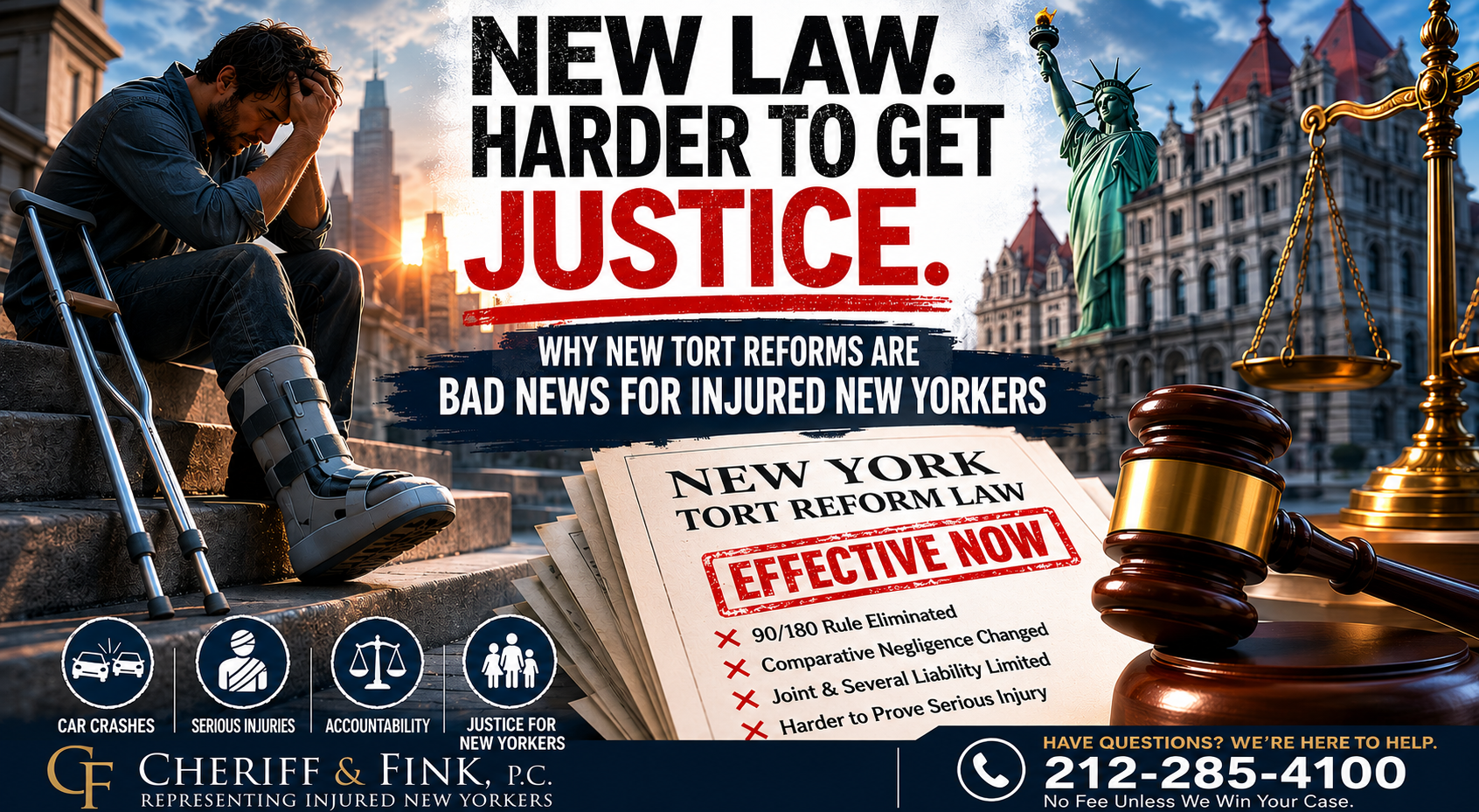
Why New York’s New Tort Reform Legislation Is Bad News for Injured New Yorkers
New York’s civil justice system has long recognized a basic principle: if someone is injured because of another person’s negligence, they deserve the opportunity to seek fair compensation. Unfortunately, sweeping tort reform legislation pushed through as part of New York’s 2026 budget negotiations threatens to dramatically weaken those protections for ordinary New Yorkers.
Supporters claim the changes are designed to combat insurance fraud and lower insurance premiums. But in reality, many of these reforms will make it harder for legitimately injured people to recover compensation — while giving insurance companies and large corporate defendants new tools to avoid accountability.
What Changed — And When Does It Take Effect?
The reforms were advanced as part of Governor Kathy Hochul’s 2026 budget package and include major changes to New York’s no-fault and personal injury laws. These changes take effect immediately!
Among the most controversial changes are:
- Elimination of the “90/180-day” serious injury category;
- Changes to comparative negligence rules;
- Higher barriers for proving “serious injury” in automobile cases;
- Additional procedural hurdles favoring insurance carriers and defendants.
For injured victims, these are not technical legal changes. They may determine whether an injured person receives compensation at all.
The End of the 90/180-Day Rule
Under New York’s no-fault system, injured motorists cannot sue for pain and suffering unless they meet the legal definition of a “serious injury” under Insurance Law § 5102(d).
One of the most important categories has long been the “90/180-day” rule. That provision allowed injured people to pursue compensation when a medically determined injury prevented them from performing substantially all of their normal daily activities for at least 90 out of the first 180 days after an accident.
The new legislation eliminates that category entirely.
Real-World Example
Imagine a 42-year-old electrician from Queens who suffers multiple herniated discs after being rear-ended by a distracted driver. He does not require surgery immediately, and he does not suffer a fracture. However, he cannot return to work for four months because he cannot safely climb ladders, carry equipment, or perform physical labor.
Under the prior law, that injured worker could potentially satisfy the 90/180-day category and pursue compensation for pain and suffering.
Under the new law, that same worker may now be told:
- “You didn’t break a bone.”
- “Your injury isn’t permanent enough.”
- “You don’t qualify.”
Despite months of lost quality of life, pain, and inability to work, the courthouse doors may effectively be closed.
The Comparative Negligence Change
Historically, New York followed a “pure comparative negligence” system. Even if an injured person was partially at fault, they could still recover compensation reduced by their percentage of fault.
For example:
- If a plaintiff was awarded $1 million but found 30% responsible, they could still recover $700,000.
The new legislation changes that framework by moving toward a modified comparative fault system that bars recovery for non-economic damages if the injured person is found more than 50% at fault.
Real-World Example
Consider a pedestrian struck while crossing a Brooklyn street outside the crosswalk. The driver was speeding and looking at a cellphone, but the defense argues the pedestrian crossed improperly.
Under New York’s prior system, even if the pedestrian was found mostly at fault, they could still recover something for catastrophic injuries.
Now imagine a jury finds:
- Driver: 49% at fault
- Pedestrian: 51% at fault
Under the revised law, the pedestrian may recover nothing for pain and suffering whatsoever. A one-percent shift in blame can completely eliminate compensation.
Insurance companies know this.
As a result, expect defense attorneys to aggressively blame injured victims for their own injuries in virtually every case.
Joint-and-Several Liability Restrictions
The reforms also narrow New York’s joint-and-several liability rules. Traditionally, injured victims could recover the full value of non-economic damages from any responsible defendant, particularly when one defendant had substantial insurance coverage.
This rule protected victims when one wrongdoer lacked insurance or assets.
Real-World Example
Suppose a delivery truck owned by a major corporation and a minimally insured driver both contribute to a catastrophic highway collision.
Previously, the injured victim could often recover the full judgment from the financially responsible corporate defendant.
Under the new rules, large defendants may only be responsible for their allocated percentage of fault — even if the other responsible parties cannot pay.
That means a jury could award millions in damages, yet the injured victim may never fully recover the compensation awarded.
Who Is Behind These Changes?
The push for tort reform has largely been driven by:
- The insurance industry;
- Business and corporate lobbying groups;
- Municipal and governmental entities seeking to reduce litigation exposure;
- Governor Hochul’s administration as part of broader budget negotiations focused on insurance costs and fraud concerns.
Supporters argue the reforms are necessary to combat staged accidents, fraudulent medical billing, and rising auto insurance premiums.
But critics — including many plaintiff’s attorneys and consumer advocates — argue the legislation unfairly punishes legitimately injured people instead of targeting actual fraudsters. They also question whether insurance companies will meaningfully reduce premiums despite receiving substantial legal protections.
Why This Matters to Every New Yorker
These reforms will not just affect “lawsuits.” They affect:
- Working people injured in car crashes;
- Pedestrians hit in crosswalks;
- Construction workers;
- Families caring for injured loved ones;
- Anyone harmed by negligence.
The civil justice system exists to provide accountability and compensation when preventable injuries occur. When access to that system is restricted, the financial burden of serious injuries does not disappear — it shifts onto injured families, healthcare providers, and taxpayers.
At Cheriff & Fink, P.C., we believe injured New Yorkers deserve meaningful access to justice and fair compensation when negligence changes their lives. It is more important than ever for accident victims to speak with experienced counsel quickly to protect their rights and understand how these changes may impact their cases.
Questions? Call us at 212-285-4100.

We're Here to Help You
Contact us today for a consultation and guidance.