
Injured by a Defective Product? Understanding Your Rights Under New York Product Liability Law
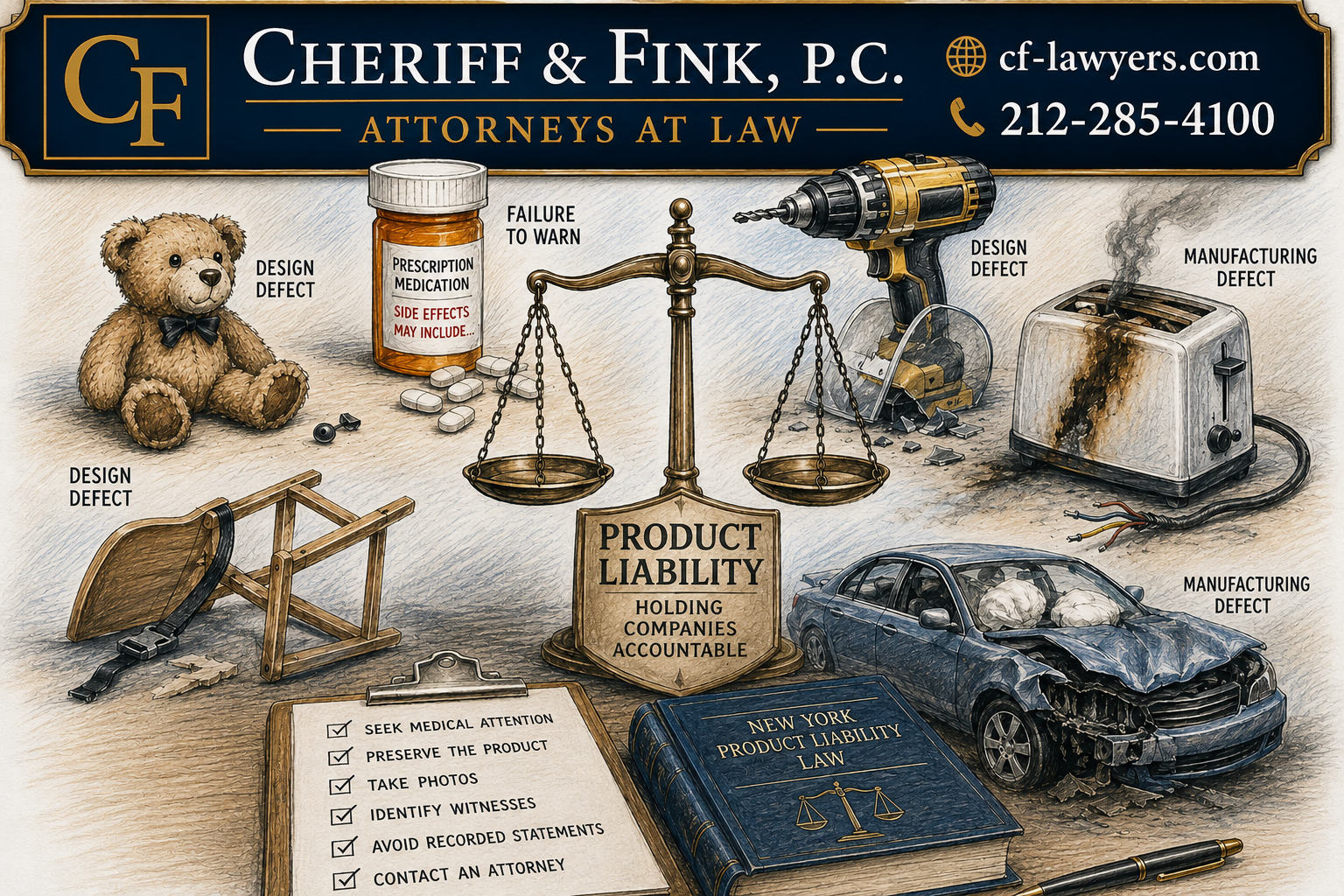
Injured by a Defective Product? Understanding Your Rights Under New York Product Liability Law
By Cheriff & Fink, P.C.
Most of us use hundreds of products every day without giving them a second thought. We trust that the car we drive, the ladder we climb, the medications we take, the appliances in our homes, and even our children’s toys have been designed and manufactured safely.
Unfortunately, that isn’t always the case.
Every year, thousands of people suffer serious injuries because of defective or dangerous products. When a product fails because of poor design, manufacturing errors, or inadequate warnings, the companies responsible may be held legally accountable.
At Cheriff & Fink, P.C., we represent individuals who have been injured by defective products throughout New York. Product liability cases are often complex, but understanding your rights is the first step toward protecting yourself and your family.
What Is a Product Liability Case?
A product liability case arises when someone is injured because a product was unreasonably dangerous or defective.
Unlike many personal injury claims, these cases often involve multiple defendants, including:
- Manufacturers
- Designers
- Component part manufacturers
- Importers
- Distributors
- Wholesalers
- Retail stores
Any company involved in placing a defective product into the stream of commerce may bear responsibility.
The Three Main Types of Product Defects
1. Design Defects
A design defect exists when the product is inherently dangerous—even if it was manufactured exactly as intended.
In other words, every product made according** to that design contains the same dangerous flaw.
Examples include:
- SUVs prone to rollovers
- Power tools lacking necessary safety guards
- Children’s toys with choking hazards
- Furniture that tips over easily
- Poorly designed ladders
- Defective medical devices
In these cases, the question becomes:
Could the manufacturer have designed a safer alternative without making the product impractical or prohibitively expensive?
2. Manufacturing Defects
Sometimes the product’s design is perfectly safe, but something goes wrong during manufacturing.
Examples include:
- Contaminated medications
- Airbags that fail to deploy
- Bicycle frames with defective welds
- Cracked vehicle wheels
- Defective electrical wiring
- Missing safety components
Here, only some of the products are defective because of errors during production.
3. Failure to Warn (Marketing Defects)
Even a well-designed product can be dangerous if users are not properly warned about known risks.
Manufacturers have a duty to provide adequate:
- Warnings
- Safety instructions
- Labels
- User manuals
Examples include:
- Prescription drugs with inadequate side effect warnings
- Chemicals without proper handling instructions
- Machinery lacking hazard warnings
- Products that require protective equipment but fail to advise users
New York Product Liability Law
New York law recognizes several legal theories that may allow an injured consumer to recover compensation.
Strict Liability
One of the most important aspects of product liability law is strict liability.
Unlike ordinary negligence cases, an injured person often does not have to prove that the manufacturer was careless.
Instead, the plaintiff generally must establish:
- The product was defective.
- The defect existed when it left the manufacturer’s control.
- The product was being used in a reasonably foreseeable manner.
- The defect substantially caused the injury.
This doctrine helps protect consumers because proving exactly what happened inside a factory or design department is often impossible.
Negligence
In some cases, injured consumers also pursue claims based upon negligence.
Examples include:
- Poor quality control
- Inadequate testing
- Failure to inspect
- Ignoring known safety problems
- Continuing to sell dangerous products after receiving complaints
Breach of Warranty
Manufacturers and sellers also make implied promises that their products are reasonably safe for ordinary use.
If those promises are broken, warranty claims may provide another avenue for recovery.
Examples of Product Liability Cases
Product liability litigation spans nearly every industry.
Examples include:
- Defective automobiles
- Faulty airbags
- Tire failures
- Dangerous pharmaceuticals
- Medical devices
- Household appliances
- Power tools
- Industrial equipment
- Children’s products
- Electric scooters
- Lithium-ion battery fires
- Pressure cookers
- E-bikes
- Helmets
- Recreational equipment
Sometimes these cases involve individual injuries.
Other times, thousands of consumers are injured nationwide, resulting in mass tort litigation or multidistrict litigation (MDL).
Common Injuries
Defective products can cause devastating injuries, including:
- Traumatic brain injuries
- Spinal cord injuries
- Severe burns
- Amputations
- Eye injuries
- Electrocution
- Broken bones
- Internal injuries
- Chemical exposure
- Permanent disability
- Wrongful death
What Should You Do If You’re Injured by a Defective Product?
The actions you take immediately after an injury can dramatically affect your ability to bring a successful claim.
1. Seek Medical Attention Immediately
Your health comes first.
Prompt medical treatment also creates important documentation connecting your injuries to the product.
Never delay treatment simply because you believe the injury will improve on its own.
2. Preserve the Product
This is perhaps the most important step.
Do not throw the product away.
Do not attempt to repair it.
Do not alter it in any way.
The defective product is often the single most important piece of evidence in the case.
If possible:
- Save the entire product.
- Keep all broken pieces.
- Preserve packaging.
- Save receipts.
- Keep instruction manuals.
- Save warranty documents.
3. Take Photographs
Document everything before anything changes.
Photograph:
- The product
- The accident scene
- Your injuries
- Property damage
- Warning labels
- Serial numbers
- Model numbers
4. Keep the Product Out of Use
If the product injured you, don’t allow anyone else to continue using it.
Doing so could result in additional injuries and may alter critical evidence.
5. Identify Witnesses
Anyone who witnessed the incident should be identified as soon as possible.
Witness testimony often becomes extremely valuable months or years later.
6. Avoid Giving Recorded Statements
Insurance companies and manufacturers may contact you quickly.
Before speaking with their investigators or signing any documents, consult an attorney.
Their interests are not necessarily aligned with yours.
7. Contact an Experienced Product Liability Attorney
These cases are significantly more complex than many other personal injury claims.
Experienced counsel can help preserve evidence, coordinate inspections, retain appropriate experts, and ensure important legal deadlines are met.
Why Product Liability Cases Are Different
Most product liability cases require extensive investigation.
Your attorney may work with:
- Mechanical engineers
- Biomedical engineers
- Human factors experts
- Accident reconstruction specialists
- Metallurgists
- Fire investigators
- Medical experts
- Economists
Experts often inspect the product, review testing data, analyze alternative designs, and explain how the defect caused the injury.
In many cases, manufacturers have teams of attorneys and experts defending the claim from day one. Having experienced legal representation can help level the playing field.
Don’t Ignore Product Recalls
Many people assume that if a product hasn’t been recalled, it must be safe.
That simply isn’t true.
Products may remain on the market for years before a recall is issued. Likewise, the absence of a recall does not prevent an injured consumer from pursuing a valid product liability claim if the product was defective.
If you discover that a product involved in your injury has been recalled, preserve the product and seek legal advice promptly.
Time Limits Matter
New York law imposes strict deadlines for bringing product liability claims. Waiting too long may permanently bar your right to recover compensation.
In addition, critical evidence—including the product itself—can be lost, altered, or destroyed if action is not taken promptly.
How Cheriff & Fink, P.C. Can Help
Product liability litigation requires experience, resources, and attention to detail. These cases often involve large manufacturers, sophisticated defense attorneys, and highly technical issues.
At Cheriff & Fink, P.C., we understand the challenges these cases present. We work with qualified experts, investigate thoroughly, preserve crucial evidence, and aggressively pursue the compensation our clients deserve.
If you or someone you love has been injured by a defective product, don’t assume it was simply an accident. A dangerous product may have caused your injuries—and the companies responsible may be legally accountable.
Contact Cheriff & Fink, P.C.
If you’ve been injured by a defective product anywhere in New York, contact Cheriff & Fink, P.C. for a consultation. We can evaluate your potential claim, explain your legal options, and help you take the next steps toward protecting your rights.
Because when companies place unsafe products into consumers’ hands, they should be held responsible for the harm those products cause.

We're Here to Help You
Contact us today for a consultation and guidance.