
Medical Malpractice vs. Medical Negligence in New York: What’s the Difference?
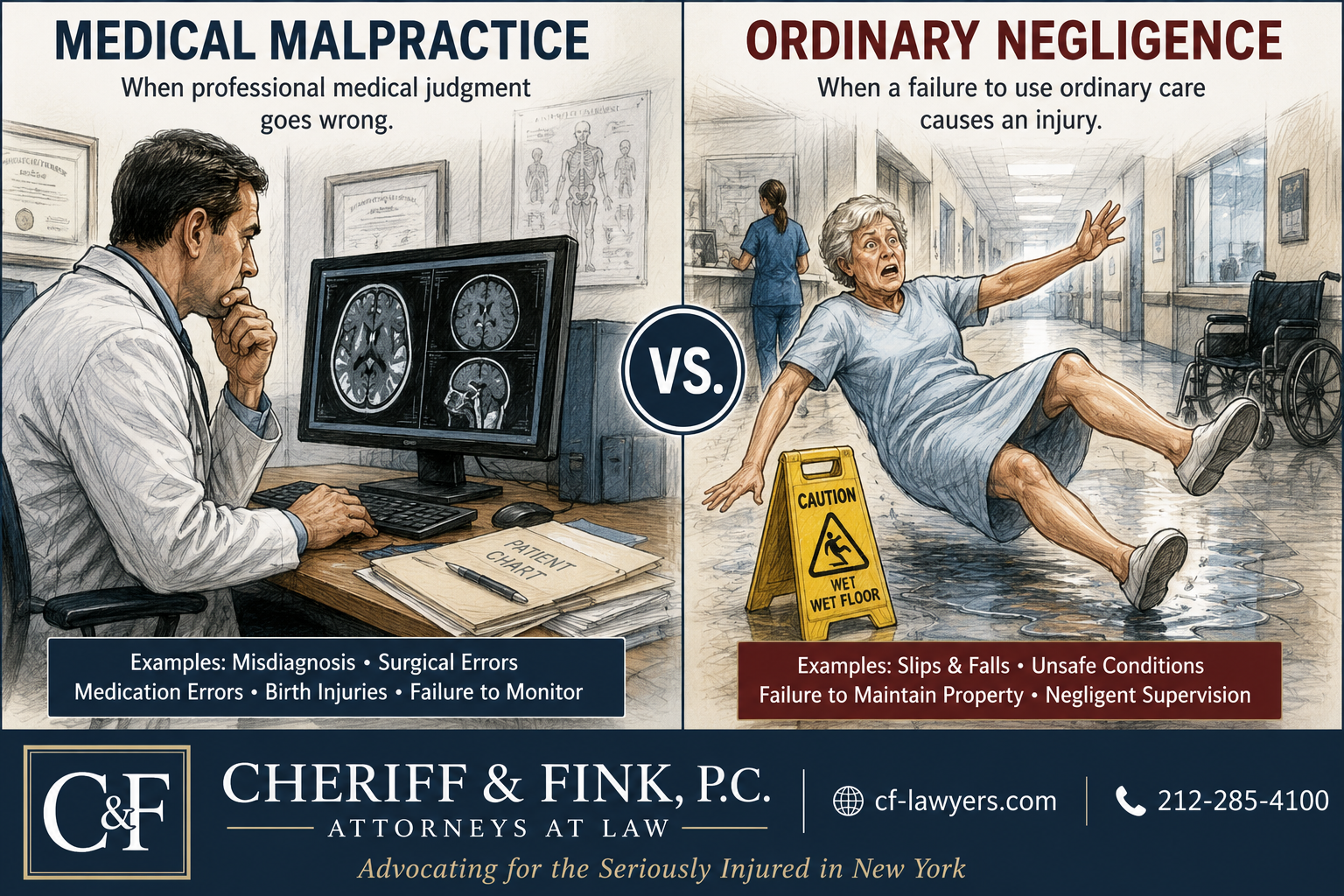
Medical Malpractice vs. Medical Negligence in New York: What’s the Difference?
By Cheriff & Fink, P.C. – Attorneys at Law
When someone is injured because of the actions of a doctor, nurse, hospital, or other healthcare provider, one of the first questions we hear is:
“Do I have a medical malpractice case?”
The answer may surprise you.
Not every injury involving a healthcare provider is considered medical malpractice under New York law. In some situations, the claim is actually one for ordinary negligence, even though it occurred in a hospital, doctor’s office, nursing home, or medical facility.
Understanding the difference is important because the legal rules, proof required, and procedures can be very different.
Medical Malpractice: Professional Medical Judgment Goes Wrong
A medical malpractice claim arises when a licensed healthcare professional departs from accepted medical standards while providing medical care or exercising professional medical judgment.
In other words, the provider did something—or failed to do something—that another reasonably competent medical professional would not have done under similar circumstances.
Examples include:
- Misdiagnosing or failing to diagnose cancer, stroke, or heart attack
- Surgical errors
- Operating on the wrong body part
- Leaving surgical instruments inside a patient
- Medication errors involving prescribing or administering drugs
- Birth injuries
- Failure to properly monitor a patient during surgery
- Delayed treatment that worsens a patient’s condition
- Improper interpretation of laboratory tests or imaging studies
- Failure to obtain informed consent before a procedure
These cases almost always require testimony from qualified medical experts who explain both:
- The accepted standard of medical care; and
- How the healthcare provider departed from that standard.
Without expert medical testimony, most malpractice cases cannot proceed.
Ordinary Negligence: When Medical Training Isn’t the Issue
Sometimes the injury has little to do with medical judgment.
Instead, it results from a failure to use ordinary reasonable care—the same standard that applies in many other personal injury cases.
These claims are generally considered ordinary negligence, even though they occurred in a medical setting.
Examples include:
- A patient slipping on a freshly mopped hospital floor with no warning signs.
- A visitor tripping over electrical cords left across a hallway.
- A hospital employee dropping heavy equipment onto a patient.
- A patient being struck by an unattended food cart.
- Failure to clean up a spilled liquid in a waiting room.
- Unsafe maintenance of hospital property.
These cases generally do not require medical experts because jurors can determine whether someone acted reasonably using common knowledge.
The Gray Area
Some cases fall somewhere in between.
For example:
Patient Falls
Suppose a hospitalized patient falls while attempting to get out of bed.
Is that malpractice or negligence?
It depends.
If the claim involves:
- Medical decisions regarding fall-risk assessments,
- Physician or nursing judgment,
- Appropriate restraints,
- Medication effects,
- Monitoring protocols,
the claim is likely medical malpractice.
However, if a nurse simply ignored a call bell for an extended period or maintenance personnel failed to repair a broken bedrail, portions of the claim may sound in ordinary negligence.
Each case must be carefully analyzed.
Improper Patient Transfers
If a patient is injured while being transferred from a wheelchair to a bed:
- If specialized medical judgment regarding the patient’s condition is involved, the claim may be malpractice.
- If staff simply failed to use ordinary care while lifting the patient, it may be negligence.
Again, the facts matter.
Why Does the Distinction Matter?
The difference affects several important aspects of your case.
Expert Witnesses
Medical malpractice cases almost always require medical experts.
Ordinary negligence cases frequently do not.
Legal Issues
Malpractice claims often involve:
- Complex medical records
- Depositions of physicians
- Expert reviews
- Detailed analysis of accepted medical practices
Negligence cases usually focus more on common safety principles that jurors encounter in everyday life.
Litigation Costs
Medical malpractice cases are generally much more expensive to litigate because of the need for multiple expert witnesses and extensive medical review.
Case Evaluation
A case that initially appears to be malpractice may ultimately be better pursued as a negligence action—or vice versa.
An experienced attorney knows how to evaluate both possibilities.
Who Can Be Liable?
Potential defendants may include:
- Doctors
- Surgeons
- Nurses
- Nurse practitioners
- Physician assistants
- Hospitals
- Surgical centers
- Nursing homes
- Rehabilitation facilities
- Medical groups
- Clinics
- Ambulance providers
In many cases, more than one party shares responsibility.
New York’s Statute of Limitations
Medical malpractice claims generally must be commenced within 2 years and 6 months from the date of the malpractice or the end of continuous treatment for the same condition.
There are important exceptions, including cases involving:
- Foreign objects left inside the body
- Certain cancer misdiagnosis claims under “Lavern’s Law”
- Injured minors
- Wrongful death
Ordinary negligence claims generally have a three-year statute of limitations.
Because determining which deadline applies can be complicated, it is essential to speak with an attorney as soon as possible after an injury.
What Should You Do If You Think Something Went Wrong?
If you or a loved one suffered an injury during medical treatment:
- Seek appropriate follow-up medical care.
- Preserve all discharge papers, prescriptions, and medical records.
- Take photographs of any visible injuries when appropriate.
- Write down everything you remember while it is fresh.
- Avoid assuming that an unfortunate medical outcome automatically means malpractice—but don’t assume the opposite either.
- Contact an experienced attorney promptly to evaluate the facts before important deadlines pass.
We Can Help
At Cheriff & Fink, P.C., we understand that injuries occurring in hospitals and healthcare settings can raise complicated legal questions.
One of the first tasks in evaluating any claim is determining whether the case involves medical malpractice, ordinary negligence, or both. That determination can significantly affect how the case is investigated, what evidence is needed, and how it is ultimately presented in court.
If you believe you or a loved one has been injured because of the actions of a healthcare provider or medical facility, we invite you to contact us for a consultation. We can review the circumstances, explain your legal rights under New York law, and help you determine the best course of action.
Cheriff & Fink, P.C. – Attorneys at Law
Offices in Nassau County and Westchester County
212-285-4100
www.cf-lawyers.com
This article is intended for general informational purposes only and is not legal advice. Every case is unique, and the outcome depends on its specific facts and applicable law.ible for the harm those products cause.

We're Here to Help You
Contact us today for a consultation and guidance.